
More for members
When you’re deciding the future of your defined benefit (DB) scheme, you want to know it will be in experienced hands.
80 years of pensions experience sits behind our run-on superfund. It’s a model built not only on knowing how to look after pensions, but on the belief that members should have the opportunity to share in the value created over time.
With regulatory assessment successfully completed and capital secured for the first £1bn to £1.5bn of transactions, TPT Superfund is ready to welcome its first schemes.

Why TPT’s Superfund?
Choosing an endgame partner means deciding who you trust with your scheme and members’ pensions for the long term.
Our Superfund is built to run on rather than target insurance buy-out, offering another option for your scheme’s future and the potential to create additional value over time. When that value is created, members have the opportunity to share in it.
Backed by decades of pensions expertise and a profit-for-purpose ownership model, we reinvest in services that support positive outcomes and long-term security.
Today, we support 66 DB schemes with in-house investment, administration, actuarial and governance expertise.
Our approach is built around three principles:

Talk to our team
If you’re considering your scheme’s endgame options or want to learn more about superfunds and consolidation, get in touch:
What is a Superfund?
A DB superfund gives you another option when considering the long-term future of your scheme.
When your scheme transfers to a superfund, the link with the original sponsoring employer is severed or materially-changed, and the superfund takes on responsibility for members’ benefits.
For schemes where insurance buy-out isn’t a viable option, that can open up another potential route.
TPT’s model is built specifically to run on, rather than targeting insurance buy-out as its ultimate destination.
-
Could a superfund be right for your scheme?
There’s no single endgame that’s right for every DB scheme. The right choice depends on your circumstances, your objectives and what you believe will deliver the right outcome for your members.
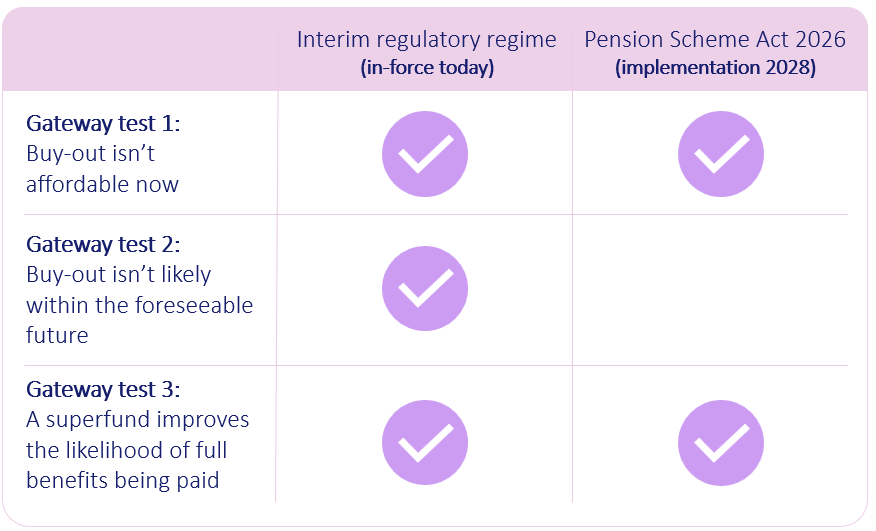
TPR’s gateway principles help trustees and sponsoring employers to assess whether a superfund transfer may be appropriate for their scheme, with requirements intended to protect members’ benefits.
Ultimately, it’s about understanding the full range of options available to you and deciding which route best meets the needs of your scheme, sponsor and members.
Achieving a successful outcome through The Pensions Regulator's assessment process enables us to bring an innovative new superfund to the market, expanding choice for trustees and sponsors. We are incredibly proud of the proposition we've built and the opportunity it creates to deliver long-term security and value for members.
At a glance
Experienced hands
You’ll have decades of pensions experience behind your scheme, with established expertise spanning investment, administration, actuarial services and governance.
Security at its core
Your members’ benefits remain the priority, supported by a model built around effective governance, financial sustainability, capital adequacy and investment risk management.
The potential for more
Running on creates the opportunity to take a longer-term, diversified investment approach and benefit from greater scale and a broader range of investment opportunities.
A stake in future success
If additional value is created, and the relevant conditions are met, your members have the opportunity to share in it through our built-in surplus-sharing mechanism.
Ready for first schemes
With regulatory assessment successfully completed and capital secured for the first £1bn to £1.5bn of transactions, we’re ready to begin onboarding schemes.

In discussion
What is a superfund and, as it becomes a more familiar endgame option for DB schemes, how will regulators and consultants adapt their approach?
Hear recent discussions on the evolving role of superfunds, featuring TPT’s David Lane, Linklaters, and our TPT Conference panellists.
Transcript
Superfunds have come quite a long way since the initial government consultation way back in 2018. I think we can safely say superfunds are no longer in the concept box. They are definitely here. They are reality.
From a corporate perspective, it is a mainstream option now. I mean, perhaps not in terms a number of transactions, but in terms of acceptance as an alternative and one that very much sort of companies and trustees should properly think about and properly do the analysis about what is the best outcome for my members, whether it is superfund buyouts or run on.
Now, that isn't to say it's the right answer in all cases. So when thinking about what is the optimal solution for a given scheme, I think you need to start looking at very much the scheme circumstances. So things like the size of the scheme, the funding level, the strength of the employer, discretionary increases and or inflationary increases within the scheme, benefits and powers under the trust deed and rules.
Clearly the one thing we can't do is you can't hurry members through the process and say, although we would like these to move faster, we do need to make sure that you're taking members as one of the key parties. But other parties as well.
In this journey, you have to reassure the members that it is a transfer and the pension scheme is still going to continue to provide those benefits, like for like, potentially there isn't going to be a loss because everybody wants to make sure that they retire comfortably. So that member communication engagement is very key when you get to that stage.
I think we can expect to see, more providers come to market with different flavours and types of offering. And I think I expect to see that superfund become pretty mainstream when it comes to schemes, thinking about what their endgame options might be.
I think competition is great, and I think then that trustees should be, putting this on the agenda, not thinking it's not for us. I think it needs to be an option alongside buyout run on, and all the rest of the end game options.
FAQs
-
What is a superfund and how does a superfund transaction work?
A superfund transaction involves the full transfer of a DB scheme’s assets and liabilities into an approved commercial consolidator. This removes the link to the sponsoring employer entirely and transfers responsibility for paying benefits to the superfund. The employer covenant is replaced with a ring fenced capital buffer designed to protect the scheme members.
-
In what circumstances might a superfund be suitable for a scheme?
A superfund may be suitable where the sponsoring employer covenant is weakened, uncertain or under strain, and full insurance buy out is not currently achievable. This can include circumstances where a recovery plan is long, employer affordability is constrained, or reliance on the employer no longer provides sufficient confidence. In these cases, a superfund can offer a broader range of endgame options and help manage risk and long term costs.
-
What regulatory requirements apply to a superfund transaction?
Before proceeding, trustees must carry out an initial assessment to determine whether a superfund transaction is likely to meet regulatory gateway requirements and support the scheme’s long term objectives. Superfunds operate under evolving legislation and guidance set by The Pensions Regulator.
-
How are scheme assets invested after a transfer to a superfund?
Following a transfer, scheme assets are invested alongside investor capital to create a capital buffer that supports benefits across a range of market circumstances. The superfund invests these assets to pay pensions over time.
Trustees should take independent investment advice as they approach a superfund transaction. They should consider how they align their investments to smooth the journey to a superfund, and what residual risks remain. Trustees should take independent investment advice when considering a transfer, to understand the investment approach and the residual risks involved.
-
How does a superfund differ from the Pension Protection Fund?
A superfund is a proactive consolidation option entered into by trustees and employers to provide full member benefits. The Pension Protection Fund provides compensation only following employer insolvency, and will provide lower benefits in most circumstances. Superfunds aim to improve long term outcomes and certainty, rather than acting as a safety net after failure.
-
What is the status of TPT’s superfund?
TPT's Superfund achieved a successful outcome, following assessment by The Pensions Regulator (TPR), in October 2026. This demonstrates that the superfund has met requirements designed to protect the security, and support the effective governance, of members’ benefits.
Find out more about the superfund, and contact us with any questions using the form above.
Related articles
-

TPTIM launches new £600m Global Equity Fund for DB members
The collective investment vehicle will be available through TPT’s own Fiduciary Management service and has been seeded with £600m of capital from TPT’s DB master trust. -

TPT to launch run-on DB superfund
TPT’s new consolidation vehicle aims to be the UK’s first TPR assessed superfund designed to run on. -

TPT appoints Ruari Grant from Pensions UK as new Head of Policy & External Affairs
In his new role, Ruari will be responsible for defining and leading TPT's policy direction and supporting the Executive Board in delivering its policy objectives. -
Shaping the future of pensions - Keynote speech
We were delighted that Pensions Minister, Torsten Bell MP, could join us to deliver the keynote speech at TPT's 'Shaping the future of pensions' event on 12 June 2025.